

Building on a lot the trucks can barely reach
Access, trades and power are what decide whether a remote build works. Four decades of delivering packages to hard sites on the British Columbia coast and beyond, and what we have learned about all three.
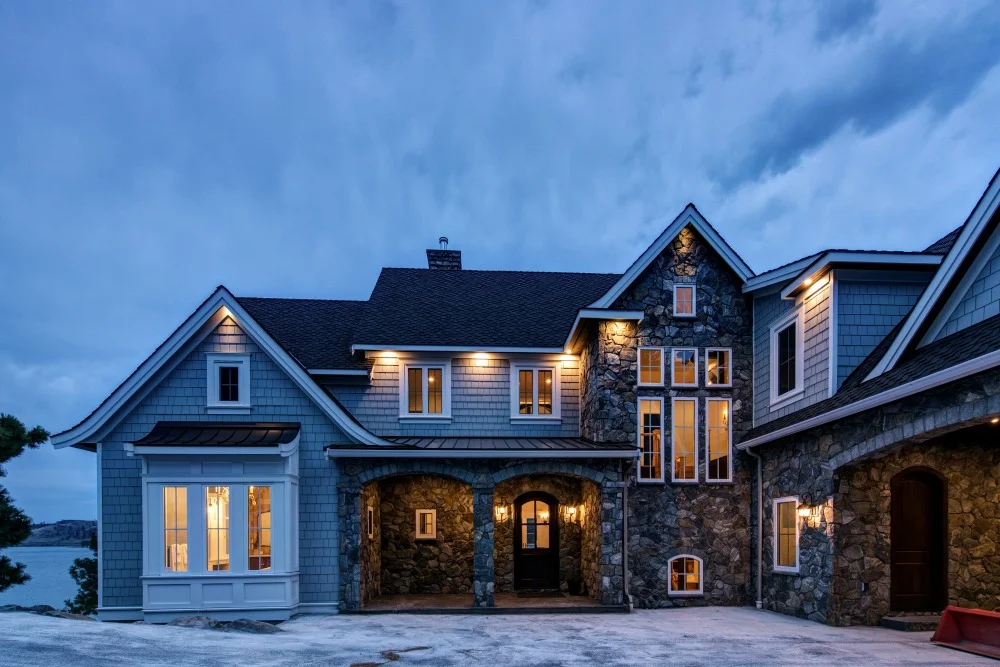
Access decides what is possible.
Before design, before budget, before anything: what can physically reach the lot, and how often. A site served only by barge, by water, or by a long forestry road rules out delivery methods that need a wide maintained route, and a modular delivery is the first thing it rules out.
Panelized packages ship flat rather than as finished three dimensional boxes, which is why they reach places volumetric modules cannot. Far more house fits in each load, and there is no oversize permit or restricted route to plan around.
Six things that decide a remote build
In the order they actually matter, which is not the order people usually think about them.
Access to trades
The single most underestimated problem, and the reason many of our remote clients end up being owner builders. Carpenters, plumbers, electricians, heating contractors, tile setters and cabinet makers may be in short supply, charging a premium for travel time, or in some places all be the same person.
Work out who they will be early, because the systems, finishes and materials chosen at design stage have to be installable by whoever is actually available. A Build Specialist can help match the specification to the labour you can get, and we have a contractor network we can recommend from.
Everything arriving with the house
On a remote site, trips to the hardware store are the hidden cost. Every one is hours, fuel and a lost half day. A prefab package arrives with the building supplies and prefabricated components already on it, secured in a job box crate, so the contractor has what the build needs without leaving the lot.
That is worth more on a remote build than on any city lot, and it is the reason a package often works out cheaper in total even where the material cost looks similar.
Power, and whether off grid is actually cheaper
There is a real upfront cost to going off grid, but bringing electricity to a distant lot can cost the same or more. The comparison is worth doing properly rather than assuming either answer. We have been part of several off grid projects along the British Columbia coast.
If you do go off grid, work out your genuine energy requirement first. A better envelope reduces the size of the system you have to build and pay for, which is where wall performance stops being an abstraction.
Protecting the house from its own site
Nature works against a building continuously, and a remote site usually means more exposure and less maintenance. Where the house sits on the land matters, and so does every exterior material choice.
Specification is the moment to deal with this. Materials that hold up in a sheltered suburb may not hold up on an exposed coastline, and the difference shows in five years rather than five months.
Using what the property gives you
If you are clearing land for a foundation or an access road anyway, a portable sawmill can turn that timber into accents for the house. It is the kind of thing only a remote build makes practical, and it connects the house to the ground it stands on in a way nothing bought can.
Design freedom, which is the reward
City bylaws slow things down and neighbours can object to what you propose. Many urban lots carry design restrictions on top. A remote lot generally lets you design for the property itself: the view, the slope, the way the light moves through the day.
That freedom is most of why people take on the difficulty in the first place. It is worth using rather than defaulting to a plan drawn for a suburban rectangle.
Site waste matters more when you are far from a landfill.
A prefabricated package cuts the waste generated on site, because cutting happens in a factory where offcuts are managed rather than on a lot where they become someone's problem to haul out.
On a remote build that is not an environmental footnote. Removing waste from a hard to reach site costs real money and real days, and the less there is to remove, the better.
Remote building questions
Access, almost always. It decides what can physically reach the site, what it costs to get there, and how many trips are practical. A lot reachable only by barge, by a long forestry road or by water rules out delivery methods that depend on a wide maintained route. Panelized packages ship flat rather than as finished modules, so they reach sites a modular delivery cannot.
Because the materials arrive with the house. Everything needed is secured in a job box crate and delivered to the lot, so a contractor is not making repeated trips to a hardware store that may be hours away. On a remote build those trips are the hidden cost, and removing them lowers the total more than most people expect.
This is the question to answer before you buy the lot, not after. Carpenters, plumbers, electricians, heating contractors, tile setters and cabinet makers may all be in short supply, charging a premium for travel time, or in some places all be the same person. Identify who they will be early, because the systems and finishes chosen at design stage have to be installable by whoever is actually available.
Sometimes the arithmetic decides it for you. Bringing power to a distant lot can cost as much as an off grid system, so the comparison is worth doing properly before assuming either. If you go off grid, work out your real energy requirement first, and understand that a better envelope reduces the size of the system you need to build.
Often, yes, and that is one of the genuine pleasures of it. City lots frequently carry design restrictions and neighbour objection processes. A remote lot usually gives more freedom to design for the property itself, the view, the slope and the way the light falls, rather than for a zoning envelope.
Building somewhere genuinely difficult? Where we deliver covers the regions we ship to most, and cabins and cottages covers the plans that suit remote sites best.
Tell us where the lot is.
Islands, backcountry, no road at all. Send the location and the access situation, and a Build Specialist will tell you honestly what is involved in getting a package there.